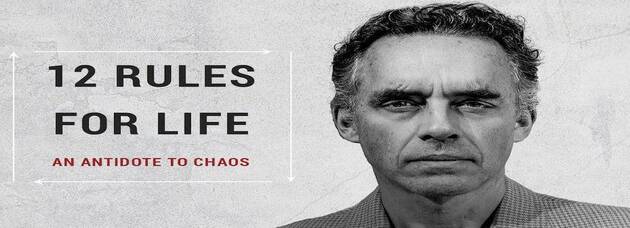
Jordan Peterson’s “12 Rules For Life” is an admixture of continental philosophy, eastern mysticism, Jungian psychology, Christian theology, clinical psychotherapy insights, personal biography, and folk wisdom. At 368 pages, it’s just large enough to keep a thoughtful layman engaged without the more intimidating academic burden of his first book, “Maps of Meaning”. Dr. Peterson is obviously well read and quite thoughtful. In addition to some of his own occasional profundities, the book is absolutely littered with references to Shakespeare, Milton, Goethe, Dostoevsky, Orwell, Solzhenitsyn, and many others.
Hume infers from his insight that it is not reason but moral opinion that moves us to act, that reason is not the source of moral opinion. From this, he then further argues that moral opinion is a product of the passions – special emotions that arise out of the relations of ideas and impressions. In this essay, I will argue that Hume’s initial inference is correct, but that his subsequent inference is not.
In recent years, it has been speculated that Jeremy Bentham was an autist. This speculation arises out of Bentham’s extreme attempts at systematizing human interactions in his formulation of Utilitarianism. Though I realize modern Utilitarianism is much more sophisticated now (in various forms of sociology and econometrics), I think they all still suffer from the fundamental assumptions laid down by Bentham. In this essay, I will show how one of those basic tenets leads to absurd conclusions, and hides imported value assumptions from other forms of ethics.
It has been put by some that Virtue ethics lacks a decision-procedure to help us make moral decisions, and is therefore, not a good moral theory. In this essay, I will argue that the decision-procedure is not a satisfactory standard for judging ethical systems because they do not take the full experience of human morality into account, and because the theories instrumenting them often achieve exactly the opposite of their stated goal.
Is it better to be truly just, or merely to seem so? This is the question put to Socrates by Glaucon in The Republic. Jonathan Haidt, in his book, “The Righteous Mind”, counts Glaucon among the cynics for putting this challenge to Socrates. But Haidt is missing a subtle and very powerful nuance in Plato’s story. Socrates had just finished embarrassing Thrasymachus for his weak defense of cynical egoism. Glaucon and Adeimantus were certainly entertained, but they were not satisfied with Socrates.
The following essay answers the question:
Are you convinced by Kant’s argument that there are categorical as well as hypothetical imperatives?
This question is not asking us to evaluate whether the consequences of a system of bifurcated imperatives is preferable or not, or to judge whether such a system could “work”. Rather, it is asking whether Kant, in his Groundwork on the Metaphysics of Morals, supplied a convincing argument that two sorts of imperatives exist.
Kant’s critique of Aristotle is fascinating to me. He uses Aristotle’s own standard against him: to say that virtue consists in achieving excellence in the unique purpose of a human life, and that this unique purpose can be identified by isolating the unique features of the organism as opposed to other organisms, you then have the problem of explaining how it is that the unique feature of reason could be better suited to helping humans achieve excellence at attaining ‘material ends’ (aka ‘happiness’), than the much more efficient and much less costly instinct, which all other animals have as well.
…When in exerting any passion in action, we chuse means insufficient for the designed end, and deceive ourselves in our judgment of causes and effects. Where a passion is neither founded on false suppositions, nor chuses means insufficient for the end, the understanding can neither justify nor condemn it. It is not contrary to reason to prefer the destruction of the whole world to the scratching of my finger. It is not contrary to reason for me to chuse my total ruin, to prevent the least uneasiness of an Indian or person wholly unknown to me.
This essay will attempt an answer to the following question: If determinism is true, is morality an illusion? In other words, if we take the basic fact of causal necessity – the brute physical explanation that every effect has a cause – as a given, can we justify a belief in moral value and normative judgment in the narrow sense of “good” and “bad”? I will argue that there are good reasons to believe in the reality of both moral judgment and moral value in spite of causal necessity.
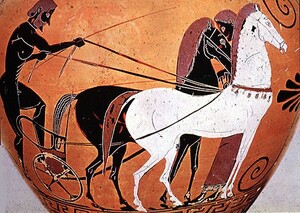
In The Phaedrus, Plato offers up two rapturously beautiful visions of the soul of man. The first, is the Manichaean winged being of pure beauty, trapped against its will in a prison of corporeal form, and able to find relief only in the apprehension and achievement of true love. The second is a famous metaphor who’s hold on the modern mind is as ubiquitous as it is distorted and tragic.