The question at hand, is whether or not the will can ever be regarded as free. Taken at face value, the obvious answer would be, “of course”. Most people, as a matter of fact, regard their will as “free”, most of the time. So, yes, it both can be, and is. Even neuroscientists like Benjamin Libet seem to think so.1 But the matter-of-fact interpretation of this question is entirely uninteresting, even as an observation.
I am working on crafting a meaningful answer to the question posed in this heading. But I have decided that the question can’t be answered until two subordinate questions can be answered. The first is “What is The Will”? and the second, “What is Freedom”? I am holding off on the latter question, for now. The following, is a compilation of my collected notes and remarks on the will itself. Hopefully, you’ll find it useful, too.
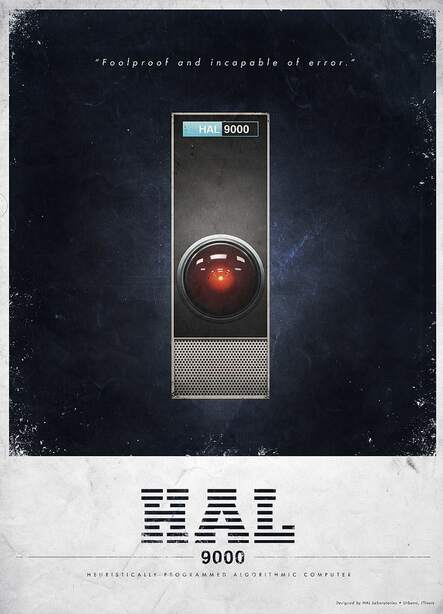
INTRODUCTION The film “2001: A Space Odyssey” is one of the best-known science fiction classics of all time. Over the decades since its initial release, this close collaboration between Stanley Kubrick and Arthur C. Clarke has become a focus of study for film students, philosophers, and futurists.
Attention tends to center on Kubrick’s depictions of space travel and its impact on human life, or on Clarke’s exploration of questions like the nature of consciousness and the ontological conundrums raised in the film’s unique climax and conclusion.
It has been asked how, if at all, one might resolve the Sorites paradox. I am not convinced a solution is possible, and in this paper I will explain the responses I have become aware of, and why they fail. In the end, I will conclude that there is no solution to the paradox, but I will offer a few suggestions for a way forward.
The first response might simply be to reject the first premise of the argument.
Susan Haack nicely diagrammed the problem of circularity in her 1976 paper, The Justification of Deduction. In that diagram, she drew a direct parallel to the circularity of the inductive justification of induction, as outlined originally by Hume. Haack argues that justification must mean syntactic justification, and offers an illustrative example argument to show why semantic justification fails – namely, that it is an axiomatic dogmatism: deduction is justified by virtue of the fact that we have defined it to be truth preserving.
The following is my attempt to answer a question posed to me recently.
When I look at the question, it seems to focus on the individual. So, I think the easiest way to begin this, is to start with the self. Since I’m no Derek Parfit or Bernard Williams, and the question seems to be focusing on moral sentiment and moral choice, I’m going to reduce the ‘self’ to just that part we always end up talking about, when we talk about choice: The Will.
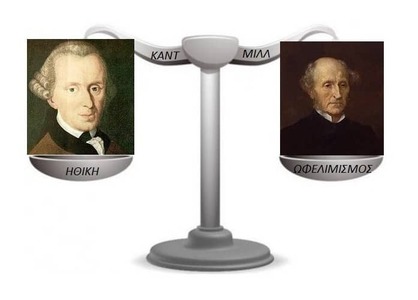
If you look closely at Mill’s arguments in Utilitarianism, he seems to be making a very strong response to Kant (perhaps against the Groundwork?). Mill accepts the notion of moral duty, just as Kant does. But he insists it derives not from any form of analytic (i.e., Kant’s notion of synthetic a priori) truth. Rather, Mill insists it derives from the apparently universal desire of mankind (individually, in aggregate) to seek its own pleasure.
The following moral dilemmas come from a Bernard Williams’ essay “A Critique of Utilitarianism” in a book entitled “Utilitarianism: For and Against”. They are presented as part of Bernard Williams’ specific objections to Utilitarianism. However, I want to use them here to talk more generally about hypothetical moral dilemmas as a tool of thought (an ‘intuition pump’, to use the Dan Dennett euphemism) in philosophy. Here are the dilemmas, as stated in Williams’ essay
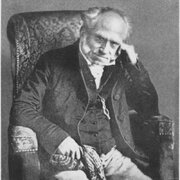
The following is a dialogue between myself and Artur Schopenhauer, in which I basically try to interrogate the text as if I were talking directly to Schopenhauer, in an interview or discussion. All of Dr. Schopenhauer’s responses below come from the text of his essay, either as direct quotes or as slight rephrasing, in order to fit them into the flow of a conversation. It should be noted that I have not read World As Will And Representation (written before this essay), and that I have only a cursory knowledge of Schopenhauer’s biography.
This weekend I attended the launch event for the International School of Philosophy here in London. Three Talks on Three Philosophers was intended to showcase the kind of thought one could expect from the new school, as well as provide an opportunity for philosophical learning to the local community (greater Islington, mainly). Sam Freemantle, the founder of the new independent school, provided the first of the three lectures, in the form of an overview of his Phd thesis, “Reconstructing Rawls”.