In his famous Paris Manuscripts of 1844, Marx argues that a society organized around the principle of private property and the commercial production of commodities forces man to stand in opposition to his own nature in order to subsist, and that this self-oppositional stance is best described as ‘alienated’ (or ‘estranged’) labor. To fully understand what Marx means by ‘alienated labor’, and under what circumstances labor becomes alienated, we must therefore first understand what Marx means by ‘human nature’.
This is only the second movie review I’ve ever done. The first was for my old video channel, which you can find on my new video channel, here . I don’t do “standard” movie reviews, because I know nothing of film production, the arcane science of camera angles and lighting, or the fine art of “pacing”, and “tone”, let alone the intricacies of acting. But once in a while, the allegorical meaning of a film jumps out at me, and I can’t help but write about it.
What’s the Goal?
In the introduction to Enlightenment Philosophy In A Nutshell, Jane O’Grady makes her intentions for the book quite explicit:
I hope to show how Descartes, Locke, Spinoza, Berkeley, Hume, Rousseau, and Kant respond to, develop, reform, and contradict the ideas of their predecessors and peers, such as Hobbes, Leibniz, Hutcheson, Voltaire, and Diderot, and in doing so, to convey the extraordinary courage and innovativeness of the Enlightenment as a whole… (Pg.
Ralph Vaughan Williams’ “Sea Symphony” is often giggled at for its overt sexual imagery, given to it by the famous poet who supplied it’s libretto. One must concede, the titterers have a point. Walt Witman’s “limitless heaving breasts”, and “husky nurse” who sings “her husky song”, are visuals that are rather hard to refute.
But, just as much as Witman’s poetry is littered with sexual symbolism, it is also laden quite heavily with religious imagery.
The world around me is getting ever more crazy, with each passing day. Politics is rapidly consuming all aspects of life within itself. We’ve reached a point in some areas of society where nothing can be considered except in terms of political relations and power dynamics. From toilet functions, to one’s choice of entertainment genres, to whom one takes as friends, to larger social and electoral questions, all things are seen through the lens of ideology now.
We are what we choose to do Whether you believe there actually is a God or not, it is still instructive to explore the conception of God provided by the religious. In particular, the difference in character between the Christian God and the Muslim God, is very interesting.
The Muslim (and perhaps Jewish) conception of God’s omnipotence is one of active and continuous expression. God is all powerful — and thus the greatest of great — because he exercises his power everywhere, at all times.
The so-called problem of induction, plainly stated, comes down to this: inductive reasoning appears to have no rational justification. Unlike deductive reasoning, which offers apparent justification in its formal structure, the form of an inductive argument can at best only offer probabilistic confidence, and at worst, no justification at all, if we examine it’s application in the context of, say, a causal explanation. To see why this is the case, let’s examine some formal examples.
The following notes are an attempt at outlining my basic thought process, to document my progress in the study of metaphysical realism, and offer the reader some food for thought. I offer it, as is. If there are any actual arguments in this post, it is purely by accident. If there are any answers to the problem of realism within this text, the reader is free to take them.
A (Very) Brief History of What Is
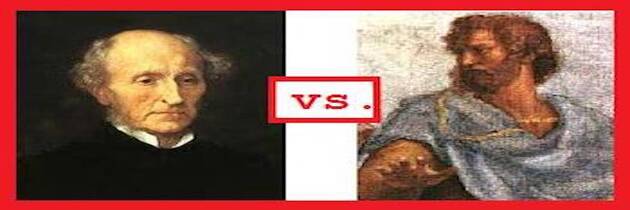
In a previous post, I outlined some significant differences between Mill and Plato on the question of Pleasure, that I think are grounded in a misreading of Plato. Here, I present a few differences between Mill and Aristotle on the summum bonum, right and wrong action, and pleasure.
When considering the arguments in Utilitarianism, and the obvious allusions to Plato and Aristotle within it, many seem to me to be incomplete at best, and misguided at worst.
Several years ago, shortly after I first started this blog, I made a decision not to engage in de jour commentary on current events and politics. One reason for that, was that I wanted the blog to be a record of my intellectual growth, and repository of whatever actual insights or knowledge I was able to produce during my formal study of philosophy. I wanted it to be a record of actual knowledge production, on my part, however meager and unimpressive that might be, as an amateur and a student.